
Names and Naming in the Ottoman Empire
The Ottoman Empire brought together Turkish, Arabic, Persian, Balkan, and other traditions, and this rich mixture can be seen clearly in personal names. Ottoman names were rarely random. They often carried religious meaning, family hopes, political symbolism, or links to earlier rulers. Some became famous through sultans and royal women, while others spread through daily life, literature, trade, and faith. Looking at these names helps explain not only how people were called, but also what kind of world they lived in.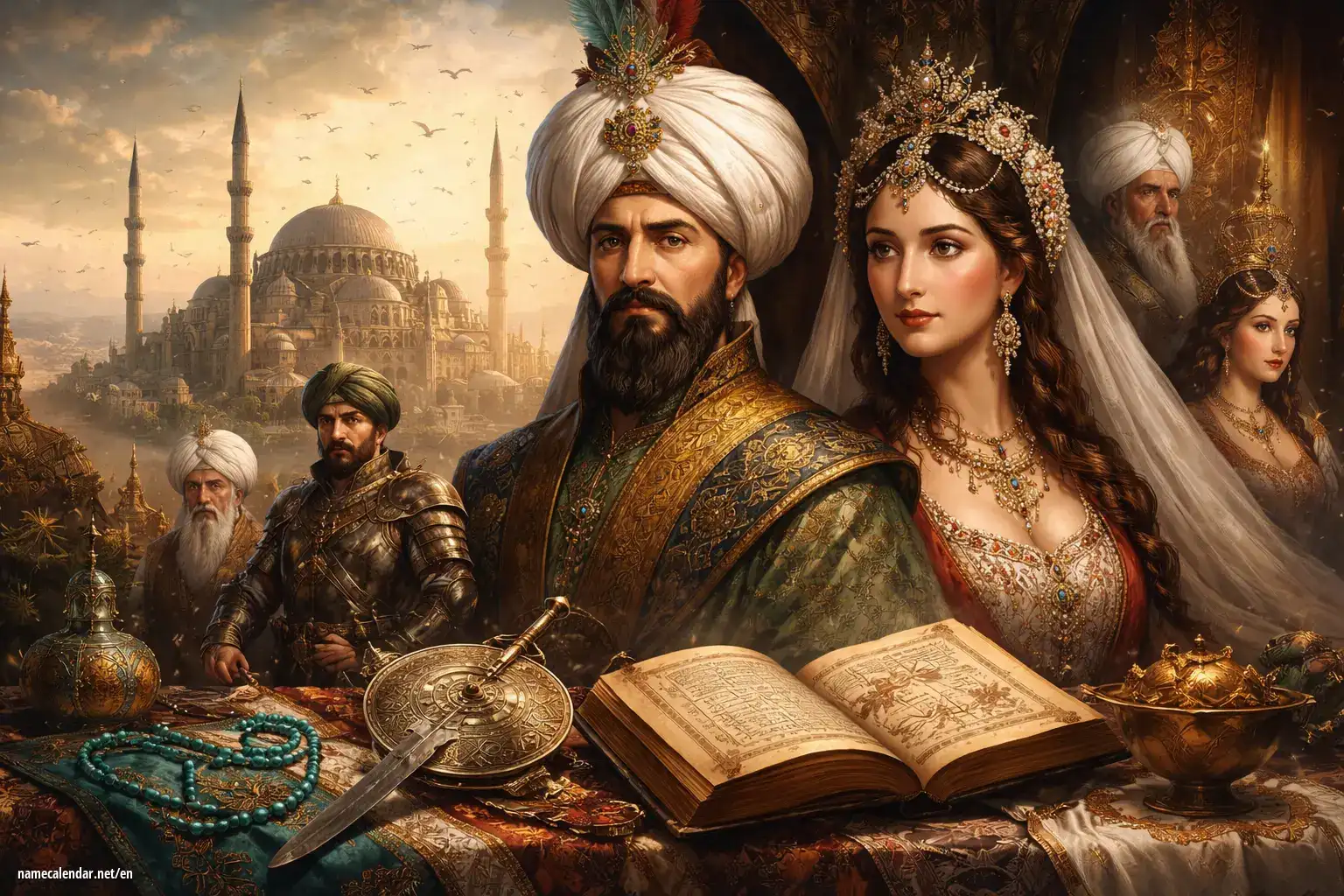
The Ottoman world of names
Names in the Ottoman Empire developed in a multilingual and multicultural environment. Ottoman Turkish itself drew heavily from Turkish, Arabic, and Persian vocabulary, so many personal names also came from those traditions. A person might bear a name with Arabic religious roots, use a Persian poetic nickname, and live in a Turkish-speaking household. In the imperial center and in the provinces, names were shaped by Islam, dynastic habits, social rank, and local custom. Because of this, Ottoman naming was both unified and diverse at the same time.Unlike many modern societies, the Ottoman world did not rely on fixed surnames in the modern sense for most of its history. People were identified through given names, patronymics, occupations, titles, places of origin, and courtly or honorific labels. This made the given name especially important. A name such as Mehmed, Ahmed, Mustafa, or Fatma could be shared by many people, but context gave it precision. Someone could be known as the son of a certain man, as a scholar, as a governor, or as a woman attached to the imperial household.
Why Ottoman names mattered
Faith, memory, and prestige
Many Ottoman names reflected devotion and respect. Names connected to prophets, companions of early Islam, admired rulers, and members of the Prophet family carried spiritual value. A name was often a statement of belonging to a wider religious civilization. Choosing Mustafa, one of the names associated with the Prophet Muhammad, showed reverence. Choosing Ali, Hasan, or Huseyin linked a family to deeply honored figures in Islamic memory.Dynasty and legitimacy
Within the ruling house, names also had political weight. Repeating names such as Osman, Murad, Mehmed, Ahmed, Mahmud, and Selim helped connect a new ruler to powerful predecessors. A dynastic name was never only personal. It could remind subjects and rivals of conquest, order, justice, or imperial expansion. In this sense, a familiar royal name acted almost like a historical message.The founder name and the memory of beginnings
Osman as a dynastic symbol
No Ottoman name is more central than Osman. The empire itself takes its common Western name from him. The founder, Osman, turned a frontier principality into a ruling house that would expand across three continents. Because of that association, the name came to symbolize origin, authority, and continuity. To use the name Osman was to recall the beginning of the dynasty and the idea of a state built from bold leadership at the frontier of empires.The name Osman has older Islamic roots and is linked to one of the early caliphs, which gave it religious dignity as well as dynastic prestige. In the Ottoman context, however, it also gained a special historical flavor. It evoked the early beylik period, warrior energy, and the transformation of a local power into an imperial one. This double value, sacred memory and political founding, made it one of the most resonant names in the Ottoman tradition.
Names of sultans that shaped Ottoman memory
Orhan and the early expansion
Orhan, the son of Osman, helped turn the early state into a more organized polity. His name remained tied to expansion in northwestern Anatolia and the first solid institutional steps of the dynasty. Though less internationally famous than some later sultans, Orhan represents the moment when the Ottoman principality became something more stable and ambitious. The name suggests practical state building rather than only heroic beginnings.Murad and royal ambition
The name Murad became one of the major dynastic names. It comes from an Arabic root meaning desire, wish, or that which is sought. In Ottoman history it was carried by several important rulers, which gave it a lasting aura of command. For many readers of history, Murad sounds forceful and purposeful, fitting a dynasty that valued military success and imperial control.Because more than one sultan bore the name, Murad came to stand for continuity within the ruling line. The repeated use of the name strengthened its association with discipline, expansion, and state power. It is also a good example of how an Arabic-origin name became entirely natural inside Ottoman Turkish political culture.
Bayezid and speed, force, and memory
Bayezid is closely linked to early imperial ambition. One famous ruler with this name became known for rapid military campaigns, helping shape the name into one associated with energy and boldness. Even when later generations remembered the disasters and reversals that could strike rulers, the name still carried grandeur. In Ottoman historical writing, names did not lose power simply because a reign ended in difficulty. Their prestige could survive through memory, legend, and state tradition.Mehmed and the prestige of conquest
Among Ottoman ruler names, Mehmed is one of the greatest. It is the Ottoman Turkish form related to Muhammad, and for that reason it already carried sacred associations. Its fame grew even further because of Sultan Mehmed II, remembered as the conqueror of Constantinople. After him, the name became inseparable from victory, imperial vision, and cultural patronage.In daily life, the name remained popular far beyond the palace. It was respected because of its connection to the Prophet and admired because of its imperial echoes. This combination made Mehmed powerful across social classes. It could suit a ruler, a scholar, a merchant, or a craftsman. Few Ottoman names show as clearly how religion and politics could strengthen each other.
Selim and stern authority
Selim is another name with lasting weight. It has an elegant sound, but in Ottoman history it often came to be linked with decisiveness and hard rule. One famous sultan with this name expanded Ottoman power dramatically into the Arab lands, bringing new religious and political prestige to the dynasty. Because of such associations, Selim often appears in history as a name of severity, strength, and strategic ambition.Suleyman and the ideal of wisdom
The name Suleyman reflects one of the richest traditions in Ottoman naming. It is connected to Solomon, a figure linked in Islamic, Jewish, and Christian traditions with wisdom, justice, and magnificence. In the Ottoman setting, the name reached extraordinary prestige through Sultan Suleyman, whose reign later generations often viewed as a high point of imperial power, law, and artistic brilliance.Because of this background, Suleyman sounded both pious and majestic. It could suggest learning, lawful kingship, and a ruler capable of balancing force with order. For a names website, it is a striking example of how one name can gather scriptural meaning, literary associations, and political glory into a single form.
Ahmed, Mustafa, Mahmud, and Abdulhamid
The Ottoman dynasty repeatedly used names such as Ahmed, Mustafa, Mahmud, and Abdulhamid. Each had religious dignity and broad appeal. Ahmed is another name associated with the Prophet, which made it especially honorable. Mustafa carried praise and chosen status. Mahmud means praised, and its sound suited rulers interested in reform as well as tradition. Abdulhamid, meaning servant of the Praiseworthy, reflects the religious pattern of devotion built into many Arabic-derived names.These names show that Ottoman dynastic naming did not depend only on uniqueness. Repetition was part of its strength. Familiar names reminded the empire that rulers belonged to an enduring house, not an isolated moment. A new sultan with an old name stepped into a chain of remembered power.
Women of the imperial household and their names
The visibility of royal women
Ottoman history is often told through sultans, but the names of influential women are equally revealing. Mothers of sultans, daughters of rulers, consorts, and charitable patrons left marks on politics, court life, architecture, and memory. Some names were rooted in Arabic religious tradition, while others reflected Persian taste, poetic beauty, or later palace culture. These women helped turn personal names into lasting historical symbols.Hurrem and joy transformed into power
Hurrem is one of the most memorable female names linked to the Ottoman court. The name carries meanings connected with cheerfulness, joy, and brightness. It fits the world of Persianate court culture, where elegance and refined emotion were prized. Yet the historical fame of Hurrem came not from poetry alone, but from the extraordinary role of a consort who became one of the best-known women in Ottoman history.Because of that association, the name Hurrem came to suggest charm joined with intelligence and influence. It is a reminder that Ottoman female names were not passive ornaments. They could become attached to diplomacy, patronage, family strategy, and the delicate politics of succession.
Mihrimah and the language of light
Mihrimah is often admired as one of the most beautiful names of the Ottoman world. It comes from Persian elements associated with the sun and the moon, giving it a luminous and poetic quality. Such a name would have sounded elegant in a courtly environment shaped by literature and symbolism. It is not merely a label, but almost a miniature image.The fame of Princess Mihrimah strengthened the name further. She became associated with wealth, charitable works, elite culture, and political visibility. Through her, the name acquired a historical reality to match its poetic form. It shows how Ottoman naming could blend aesthetics and public memory.
Nurbanu, Kosem, and palace identity
Names such as Nurbanu and Kosem reveal another side of Ottoman female naming. Nurbanu combines ideas of light and ladyhood, creating a name that sounds radiant and noble. Kosem became famous through one of the most powerful women of the seventeenth century. In the palace world, such names often carried carefully shaped identities. They could signal refinement, favor, and status within the imperial household.These names are important because they remind us that the Ottoman elite was not ethnically simple. Women of varied origins entered the palace system, and their names, or the names by which they became known, could reflect adaptation into Ottoman court culture. The result is a naming landscape that is both imperial and cosmopolitan.
Fatma, Ayse, and Hatice
Not all well-known Ottoman female names were rare or highly poetic. Some of the most important were also among the most familiar. Fatma, related to Fatimah, carried strong Islamic prestige. Ayse, linked to one of the Prophet wives, was beloved across many Muslim societies. Hatice, connected to the Prophet first wife, also held deep dignity. In the Ottoman context these names could belong both to women of the palace and to women in ordinary households.The popularity of names like Fatma, Ayse, and Hatice shows that Ottoman naming was not separated sharply between elite and common life. The same name could move between court records, charitable foundations, private letters, and family memory. That broad reach helped such names remain important long after the empire ended.
Religious names and the prestige of Islamic tradition
Prophetic and sacred associations
One of the strongest naming currents in the Ottoman Empire came from Islam. Names tied to prophets, early Muslim figures, and the family of the Prophet carried special respect. Ibrahim, Musa, Yusuf, Ismail, Suleyman, and Isa all belong to the shared scriptural world that shaped Ottoman culture. Their meanings and stories made them more than attractive sounds. They connected the individual to sacred history.These names remained popular because they were flexible. A ruler could bear one, but so could a village farmer or an urban artisan. They were understood across regions and languages. In an empire that stretched across many lands, such names provided a common cultural vocabulary.
Names linked to devotion
Other names expressed devotion more directly. Forms such as Abdullah, Abdurrahman, Abdulkadir, and Abdulhamid use the pattern of servanthood to God through one of the divine names or attributes. This made them especially meaningful in religious terms. Such names show the close relationship between language and piety in Ottoman society.Ottoman naming was not unique in using these patterns, but the empire helped spread and preserve them across large regions. A name of this type could signal humility before God, but it could also carry dignity and learning. In legal records, religious circles, military service, and courtly life, such names were thoroughly at home.
Arabic, Persian, and Turkish influences in one naming culture
Arabic foundations
Arabic supplied many of the most prestigious Ottoman names because it was the language of the Quran and of much religious scholarship. Names such as Ahmed, Mustafa, Mahmud, Ali, Hasan, Huseyin, Omer, and Osman carried authority grounded in faith and early Islamic history. These names often appeared simple and direct, but behind them stood centuries of religious and literary tradition.Persian elegance
Persian influence entered Ottoman naming especially through court culture, poetry, and refined urban taste. Names such as Hurrem, Mihrimah, Nurbanu, and Shah-based compounds reveal this world of ornament and symbolism. Persian naming added delicacy, beauty, and literary color. It was particularly visible in elite female names, court nicknames, and artistic circles, though not limited to them.Turkish continuity
Turkish naming never disappeared under Arabic and Persian influence. Instead, Ottoman culture fused them. Some names had clearly Turkic roots, while others were Arabic or Persian forms pronounced and adapted in Turkish ways. This mixing is one reason Ottoman names can feel so layered. A single name can belong to more than one cultural history at once.Names beyond the palace
Urban life, villages, and ordinary memory
The names that survive in imperial chronicles are only one part of the picture. Across the empire, ordinary people used many of the same names as their rulers, but with different local accents and habits. Men called Mehmed, Ali, Hasan, Mustafa, or Ibrahim could be found in markets, workshops, farms, ships, and military barracks. Women named Fatma, Ayse, Zeynep, Hatice, or Emine appeared in family histories, foundation records, and court documents.This wide social spread is one reason Ottoman names still feel familiar in many places once touched by Ottoman rule or influence. They belonged not only to dynastic spectacle, but also to daily life. A name was something heard in the street, recited in prayer, written in contracts, and remembered in family lines.
Regional variation
Because the empire covered southeastern Europe, Anatolia, the Arab lands, and North Africa, the same name could appear in different forms from place to place. Pronunciation, spelling, and preference varied. Some regions favored certain saints, scholars, or local heroes. Others leaned more strongly toward Arabic or Turkish naming habits. The Ottoman Empire did not erase local custom. It created a framework in which many naming traditions could overlap.How titles and names worked together
To understand Ottoman names fully, it helps to remember that a given name often appeared together with titles such as bey, pasha, efendi, hanim, or sultan. These were not part of the personal name in the modern sense, but they shaped how the individual was perceived. A simple name like Ahmed or Fatma could sound very different depending on whether it was paired with a courtly, military, scholarly, or domestic title.This system also explains why some Ottoman names became famous in longer forms. Historical memory often preserves a name together with rank or relationship. Yet beneath these layers, the personal name still mattered most. It was the durable core that survived when titles changed, offices ended, or dynasties declined.
Names that carried stories
Yusuf as beauty and patience
Yusuf was admired not only as a prophetic name, but also because the story of Joseph carried themes of beauty, endurance, betrayal, and eventual triumph. In a literary culture, such a name was rich with emotion. It could suggest both physical grace and moral strength. Ottoman poetry and storytelling helped keep these associations alive.Ali as courage and honor
Ali was beloved across much of the Islamic world, and the Ottoman Empire was no exception. The name evoked bravery, loyalty, and spiritual dignity. Because of its short, powerful form and deep historical roots, it worked well in every layer of society. It is a model example of how a compact name can hold immense symbolic force.Zeynep and enduring grace
Zeynep became one of the most enduring female names in Ottoman and post-Ottoman lands. Its popularity rested partly on its connection to the family of the Prophet and partly on its soft, graceful sound. In the Ottoman context it could feel both intimate and dignified. Unlike some names tied mainly to the court, Zeynep belonged easily to ordinary life as well.The long afterlife of Ottoman names
Many names from the Ottoman Empire survived the empire itself. They passed into modern Turkey, the Balkans, the Middle East, and diasporic communities around the world. Some retained a clear Ottoman aura, especially names strongly associated with sultans or palace women. Others became so common that their imperial past faded into the background, even though it had helped preserve and spread them.Today, names such as Osman, Mehmed, Ahmed, Mustafa, Suleyman, Selim, Fatma, Ayse, Zeynep, and Hatice still carry echoes of Ottoman history. They may now feel modern, traditional, religious, or familial depending on the setting, but they also remain historical bridges to a vast imperial past.
Why these names still attract attention
Names from the Ottoman Empire continue to interest readers because they combine sound, meaning, and history in unusually rich ways. A single name can point to empire, faith, poetry, conquest, family loyalty, or female patronage. Some names feel grand and ceremonial, while others feel warm and domestic. Together they show that Ottoman culture was not one-dimensional. It was shaped by rulers and ordinary people, by religion and literature, by continuity and change.For anyone exploring names, the Ottoman world offers a remarkable collection. It includes founder names, royal names, sacred names, poetic names, and everyday names that lasted for centuries. Studying them reveals not only what people were called, but what values they honored and what memories they wanted to preserve.