
Byzantine Empire Names and Their Stories
The Byzantine Empire preserved Roman statehood, embraced Greek language and Christian faith, and connected Europe with the eastern Mediterranean for more than a thousand years. Its names reflect that layered world. Some came from ancient Greece, some from Rome, some from the Bible, and some from the language of saints, soldiers, and emperors. A Byzantine name was rarely just a label. It could express family memory, religious devotion, education, political ambition, or regional identity. Looking at these names opens a clear path into everyday life, court culture, and the spiritual imagination of Byzantium.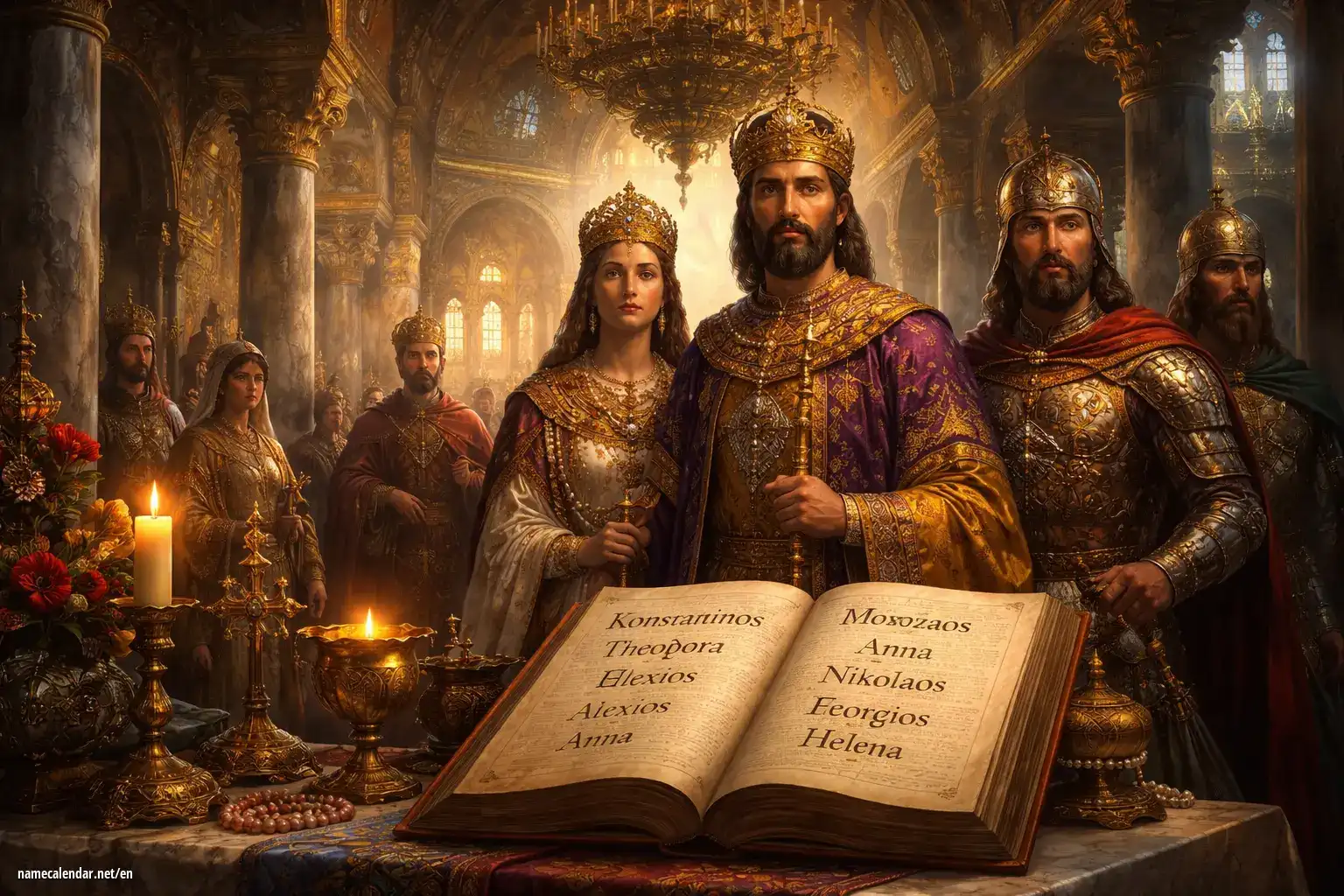
What made a name Byzantine
A Byzantine name was shaped by continuity and change at the same time. The empire called itself Roman, yet most of its people spoke Greek. It inherited classical traditions but lived in a strongly Christian society. Because of that, names from many different sources stood side by side. A man might carry a classical name such as Leon, a biblical name such as Ioannes, or a saintly name such as Nikolaos. A woman might be named Helena, Anna, or Theodora, each carrying its own cultural world.Many Byzantine names were older than the empire itself. Greek names from antiquity survived because they still sounded prestigious and meaningful. Roman names survived in Greek form, though often with less importance than in earlier Roman society. Biblical names spread through liturgy, scripture, and the cult of saints. Over time, Christian naming grew stronger, especially after late antiquity, and names associated with holy figures became increasingly common.
Yet Byzantine naming was never fully uniform. Court circles, provincial towns, monasteries, military families, merchants, and peasants did not all choose names in the same way. Some families repeated names across generations to show continuity. Others selected names from local saints. Others preferred names associated with powerful dynasties. This variety is part of what makes Byzantine names so rich to study.
Greek roots and the survival of ancient tradition
Classical forms that remained alive
Many Byzantine names came directly from ancient Greek tradition. These names survived not because Byzantines were trying to imitate the distant past in a simple way, but because Greek literary culture remained active. Educated people still read ancient texts, and classical language retained prestige. Names such as Andronikos, Demetrios, Georgios, Konstantinos, and Theodoros felt familiar within a living tradition rather than as museum pieces.Some of these names had transparent meanings in Greek. Andronikos combines elements connected with man and victory, giving it a martial and noble tone. Theodoros means gift of God, blending Greek language with Christian belief so naturally that the name belonged to both worlds. Demetrios originally pointed to the goddess Demeter, yet in Byzantine society it was strongly linked to Saint Demetrios of Thessaloniki. A pre-Christian name could therefore enter Christian life without losing its linguistic beauty.
Why old names stayed attractive
Ancient Greek names continued to appeal because they sounded educated, dignified, and culturally rooted. Byzantium did not reject the classical inheritance. Instead, it reinterpreted it. Names such as Sophia, meaning wisdom, and Eirene, meaning peace, were valued for their meaning and elegance. They could evoke philosophy, imperial rhetoric, and Christian virtue all at once.That continuity gave Byzantine naming a special texture. In some medieval societies, ancient pagan names largely disappeared. In Byzantium, many remained usable because language, learning, and religion were woven together in complex ways. A name could carry memories of antiquity while fully serving the needs of a Christian empire.
Imperial names and the language of power
Names made famous by emperors
Certain names became especially prominent because emperors and ruling families used them repeatedly. When a name reached the throne, it gained prestige across the empire. Konstantinos is one of the clearest examples. Its fame owed much to Constantine the Great, whose legacy shaped Christian empire itself. Later Byzantine rulers used the name again and again, and it became one of the most enduring names in the Greek world.Alexios rose sharply in prestige after the Komnenian period, especially because of Emperor Alexios I Komnenos. The name comes from a Greek root meaning to defend or help, which made it especially suitable for imperial propaganda in an age of military and political recovery. A ruler named Alexios could be imagined as the protector of the empire, the church, and the people.
Manuel became another powerful imperial name, especially through Manuel I Komnenos. Unlike many older Greek names, Manuel has a biblical background through its relation to Emmanuel, meaning God is with us. In Byzantium it acquired a refined courtly tone and later spread beyond Greek-speaking lands.
Feminine names at court
Imperial women also shaped naming fashion. Theodora became unforgettable through Empress Theodora, the wife of Justinian I. The name means gift of God and has a stately, ceremonial quality. Because Theodora herself was remembered as intelligent, forceful, and politically influential, the name came to suggest female authority as well as piety.Zoe, meaning life, was borne by empresses and noblewomen and carried both spiritual and dynastic resonance. Eudokia, which suggests good will or good repute, was another aristocratic name with an elegant sound. Anna became especially prominent in educated and courtly circles, and the fame of Anna Komnene, historian and princess, added intellectual prestige to a name already rooted in biblical tradition.
When imperial families repeated names generation after generation, they were doing more than honoring relatives. They were building dynastic memory. To name a child Konstantinos or Theodora could be a symbolic act, tying the child to earlier rulers, political ideals, and the aura of legitimacy.
Christian faith and the spread of saintly names
From scripture to baptism
As Christianity became central to Byzantine identity, names linked to scripture and saints spread widely. Baptism gave naming a sacred dimension. A child named Ioannes was not only receiving a respected personal name but also entering a Christian community shaped by Saint John the Baptist or Saint John the Evangelist. The same was true for Maria, Anna, Petros, and Paulos.Some of these names came from Hebrew through Greek Christian usage. Maria carried immense reverence because of the Virgin Mary. Anna was associated with the mother of Mary and became beloved throughout the Christian East. Ioannes became one of the most widespread male names because it linked the bearer to holiness, prophecy, authorship, and liturgical memory.
Saints as local and personal patrons
Names also spread through devotion to specific saints. Georgios became powerful because Saint George was revered as a soldier saint and protector. Nikolaos grew in popularity through the fame of Saint Nicholas, known for charity, miracles, and pastoral care. Demetrios had exceptional status in and around Thessaloniki because Saint Demetrios was viewed as the citys heavenly guardian.This saintly pattern made naming deeply personal. A family might choose a name because a saint had helped them, because a church nearby was dedicated to that saint, or because a feast day coincided with a birth. In this way, Byzantine names often tied private life to public worship. They connected a household to the liturgical year, to pilgrimage sites, and to local memory.
Christian naming also encouraged moral ideals. A person named Eirene could be associated with peace, a person named Agathe with goodness, and a person named Charis with grace. Even when these were not the most common names, they reveal how language itself could turn virtue into personal identity.
Famous male names from Byzantium
Konstantinos
Konstantinos comes from the Latin name Constantius and is linked with firmness and constancy. In the Byzantine world, its meaning was strengthened by imperial history. Because of Constantine the Great and later emperors of the same name, Konstantinos became a model of legitimate Christian rulership. It was formal, weighty, and durable, which helps explain why it remained popular long after Byzantium ended.Alexios
Alexios comes from a Greek verb meaning to defend or protect. That made it especially suitable in a society that valued military leadership and imperial guardianship. The name carries energy and confidence, but it is also humane in tone, since to defend can mean to help as well as to fight. Its rise under the Komnenoi shows how politics can transform a personal name into a dynastic emblem.Nikolaos
Nikolaos combines victory and people, creating a name that sounds both public and triumphant. In Christian Byzantium, however, its fame was shaped above all by Saint Nicholas. The result is a name that joins authority with kindness. It could suit a bishop, a merchant, a sailor, or a child in an ordinary household. Few Byzantine names show such a balance between prestige and warmth.Georgios
Georgios originally means farmer or worker of the earth. That humble agricultural sense gained a heroic new life through Saint George. In Byzantium the name could therefore carry two different kinds of dignity: the dignity of labor and the dignity of sanctified courage. This duality made it widely attractive across social classes.Theodoros and Ioannes
Theodoros means gift of God, a meaning that fit Christian family life perfectly. Parents could name a son Theodoros as an expression of gratitude for his birth. Ioannes, by contrast, came with immense scriptural and liturgical authority. It was one of the safest and strongest names in Byzantine society, able to suit monks, scholars, officials, and emperors. Together, these names show how meaning and religious memory worked together in Byzantine naming.Famous female names from Byzantium
Theodora
Theodora is the feminine form of Theodoros and means gift of God. It became one of the grandest female names in Byzantium, partly because of its theological beauty and partly because of imperial association. Theodora, wife of Justinian I, left a strong mark on historical memory, so the name came to suggest intelligence, force, and splendor as well as devotion.Anna
Anna has biblical roots and conveys grace or favor. In Byzantium it was elegant without being remote. It could belong equally to a princess, a writer, a saintly woman, or a mother in an ordinary household. The literary fame of Anna Komnene gave the name a rare learned aura, linking it not only with piety but with authorship and historical memory.Zoe and Sophia
Zoe means life. That simple meaning gave it great spiritual and emotional power in Christian culture, where life could suggest both earthly vitality and eternal salvation. Sophia means wisdom and had deep roots in Greek thought. In Byzantium the name could evoke philosophical culture, sacred wisdom, and the monumental prestige of Hagia Sophia, even though the church name itself refers to Holy Wisdom rather than a saint named Sophia in the simplest sense.Eirene and Helena
Eirene means peace, making it one of the most transparent and attractive Byzantine names. It was especially suitable in imperial rhetoric, where peace was celebrated as a sign of good rule. Helena carried the prestige of Saint Helena, mother of Constantine the Great, and was associated with piety, pilgrimage, and imperial motherhood. Both names show how virtue and historical memory strengthened female naming traditions.Other important female names included Eudokia, Maria, Kassia, and Anastasia. Anastasia, meaning resurrection, is especially revealing. It shows how central Christian theology could become in personal naming. To give that name was to place a child under the sign of Easter hope itself.
Names in literature, monastic life, and learning
Writers and scholars
Byzantine literature preserved the names of historians, poets, theologians, and scholars whose personal names still feel distinctive today. Photios suggests light and is memorable because of Patriarch Photios, one of the most learned figures in Byzantine history. Michael, though biblical rather than uniquely Byzantine, became common among emperors, intellectuals, and officials, showing how a single name could move across all levels of society.Kassia is another striking example. Known as a poet and hymnographer, she gives visibility to a female name that feels refined, memorable, and deeply connected with Byzantine artistic culture. Some names survived not only because they were common, but because an exceptional bearer gave them a special literary afterlife.
Monastic names and spiritual identity
Monastic life added another layer to Byzantine naming. When men and women entered monasteries, they could receive new names or live under names that emphasized humility, holiness, or scriptural connection. Names such as Makarios, meaning blessed, or Basileios, associated with Saint Basil the Great, had strong spiritual resonance. Anastasios and Anastasia reflected resurrection, while Gregorios linked a person to important bishops and theologians.These names mattered because Byzantium was a society where monasteries were cultural centers. A monastic name could eventually influence lay naming as well. Families admired holy monks, nuns, bishops, and abbots, so names circulating in spiritual communities often entered general use. Religious prestige therefore shaped the naming pool beyond the walls of the cloister.
Military, administrative, and aristocratic naming
Byzantium was a courtly and military empire, and this affected naming style. Aristocratic families often repeated names that had already brought success in politics, command, or marriage alliances. If a family had produced a famous Andronikos, Nikephoros, or Isaakios, those names might reappear in later generations. Repetition turned a personal name into a family resource.Nikephoros means bearer of victory and had obvious appeal in military culture. Isaakios, derived from the biblical Isaac, gained extra prestige from imperial use. Basileios, related to kingship or royalty in Greek sound and association, became especially important through Basil I and Basil II. These names reveal how ambition, rank, and symbolic language worked together.
Aristocratic naming could also be conservative. Noble houses often preferred names already honored by family tradition. That conservatism helped maintain continuity, but it could also send a public message. A boy named Basileios or Konstantinos in an elite family was visibly placed within a network of ambition and memory. A girl named Theodora or Anna might likewise embody lineage and expectation.
Even so, Byzantium did not divide names strictly by class. Popular saint names crossed social boundaries with ease. A court official and a village farmer might both be named Georgios. What changed was not always the name itself but the family stories, titles, and social opportunities attached to it.
Regional diversity across the empire
From Constantinople to the provinces
The Byzantine Empire covered a vast and changing territory, so naming was never identical everywhere. Constantinople, as the imperial capital, often set fashionable patterns, especially through the court and church hierarchy. Yet cities such as Thessaloniki, Trebizond, Antioch, and many provincial centers had local saints, regional elites, and linguistic influences of their own. A name common in one region might feel more prestigious, more devotional, or simply more ordinary in another.Greek was dominant in much of the empire, but Byzantine society also included speakers of Armenian, Syriac, Slavic, Latin, and other languages. This produced adaptation and overlap. Some names moved easily across these worlds, changing form as they traveled. Konstantinos, Anna, Maria, and Nikolaos all had lives beyond one linguistic community.
Borrowing and transformation
Names were often reshaped when they crossed borders. A biblical or Greek name might acquire a local pronunciation, a shortened form, or a new spelling. This process is one reason Byzantine naming influenced so many later traditions in the Balkans, Eastern Europe, and the eastern Mediterranean. The empire served as a powerful channel through which names circulated, were translated, and acquired new prestige.That cultural movement also explains why some names that feel modern today have deep Byzantine roots. When families in later Orthodox lands used names such as Anastasia, Dimitrios, Eleni, or Vasileios, they were often continuing patterns strengthened by Byzantine religion and prestige.
How Byzantine names were formed and understood
Meaningful elements inside names
One of the most appealing features of Byzantine names is that many were still semantically vivid. Greek speakers could often feel the meaning of a name. Theodoros and Theodora clearly contained the element for God and the idea of gift. Nikolaos joined victory with people. Philippa or Philippos pointed to love of horses from older Greek tradition. Makarios suggested blessedness. These meanings were not always the main reason a parent chose a name, but they gave names extra depth.Some names became popular because their meaning suited Christian values. Anastasios and Anastasia referred to resurrection. Eirene meant peace. Sophia meant wisdom. Such names offered a kind of spoken theology within family life. They turned abstract ideals into daily forms of address.
Short forms and everyday use
Daily life also produced shortened and familiar forms, just as in many cultures today. Formal names used in documents or ceremonies could exist alongside affectionate household versions. Although surviving written sources often preserve fuller forms, it is likely that families regularly used diminutives, nicknames, or shortened versions in speech. This reminds us that Byzantine names belonged not only to emperors and manuscripts but also to kitchens, markets, streets, and schoolrooms.Surnames became more important in the middle and late Byzantine periods, especially among elites, but the personal name remained central. It was the first marker of identity and often the carrier of a persons spiritual, familial, and cultural world.
Legacy of Byzantine names after the empire
When the Byzantine Empire ended, its names did not disappear. They continued in Greek-speaking communities, in Orthodox Christian lands, and in regions influenced by Byzantine liturgy and culture. Names such as Konstantinos, Georgios, Nikolaos, Anna, Sophia, Helena, and Anastasia remained alive because they were supported by religion, family tradition, and historical memory.Some passed into many European languages in modified form. Konstantinos became Constantine or Konstantin in other settings. Ioannes produced forms such as John, Jean, Ivan, and many more through different language histories. Helena became Elena, Helen, Jelena, and related forms. Byzantine culture did not create every one of these names, but it played a major role in preserving, reshaping, and transmitting them.
The endurance of these names reveals something essential about Byzantium. The empire was not only a political power; it was also a great preserver and transmitter of culture. Through liturgy, education, court ceremony, art, and family practice, it helped carry ancient, biblical, and Christian names into the medieval and modern worlds.
Why Byzantine names still fascinate today
Names from the Byzantine Empire remain attractive because they combine beauty, meaning, and history. Many sound elegant and strong. Many carry layers of interpretation that reflect the empires mixed heritage. A name such as Theodora is at once Greek in language, Christian in meaning, and imperial in memory. A name such as Alexios sounds active and protective. A name such as Zoe is brief but spiritually rich.They also fascinate because they resist simple labels. Byzantine names are not only Greek, not only Roman, and not only biblical. They belong to a civilization where all these streams met. To study them is to see how people understood dignity, sanctity, ancestry, and hope. In that sense, the history of Byzantine names is really the history of Byzantium itself told in miniature.
For anyone interested in name traditions, Byzantine names offer an exceptional field of study. They show how names can travel across centuries, survive changes of religion and power, and still feel vivid in the present. Their stories are not frozen in the past. They continue wherever these names are spoken, celebrated, and passed from one generation to the next.