
Bronze Age Names and Their Lasting Legacy
The Bronze Age left behind cities, tablets, royal monuments, and trade routes, but it also left names. Those names are more than labels. They preserve prayers, loyalties, family hopes, political messages, and memories of gods. When we study Bronze Age names, we do not simply collect old sounds. We enter a world where a personal name could declare divine favor, link a child to a city, or carry prestige across languages and empires.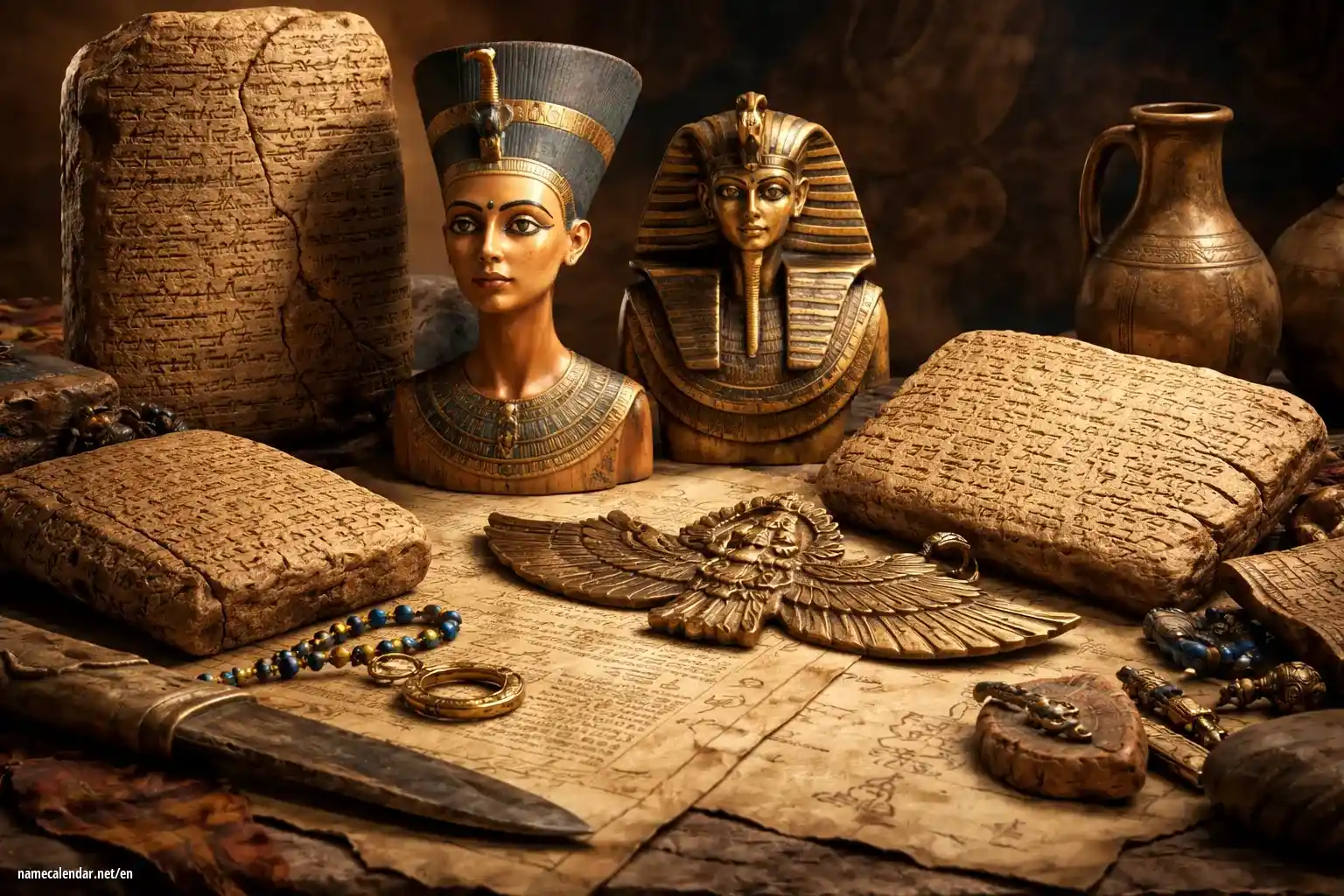
Why Bronze Age names still matter
Bronze Age names matter because they sit at the meeting point of language, belief, and identity. In many early societies, a name was not chosen only because it sounded beautiful. It could function almost like a short sentence. It might thank a god, ask for protection, celebrate birth, announce family status, or connect the child with a ruler, a city, or a cult. This gives ancient names a special richness. A modern reader often sees a short personal name. A Bronze Age parent may have heard a blessing, a vow, or a statement about the world.Another reason these names matter is that they survived in very different ways. Some remained famous because they belonged to kings and queens. Some entered religious tradition. Some were preserved in epic memory. Others vanished from everyday use but lived on in inscriptions, clay tablets, and archaeology until modern scholarship revived them. Their legacy is therefore not only linguistic. It is cultural. A Bronze Age name may survive because it was carved in stone, copied by scribes, remembered in poetry, or rediscovered in a tomb thousands of years later.
Egyptian names as sacred statements
Royal names and divine favor
Ancient Egypt offers some of the clearest examples of meaningful Bronze Age personal names. Egyptian naming often tied human identity to the divine world. A name could announce that a god had acted, shown favor, or shaped the child’s destiny. The name Amenhotep is usually understood as “Amun is satisfied” or “Amun is pleased,” which turns a personal name into a religious statement. The name Tutankhamun means “living image of Amun,” and it shows how royal identity could be expressed through closeness to a major deity. Ramesses is commonly explained as “born of Ra,” again linking the bearer to divine power. Even a name like Nefertiti, usually taken as “the beautiful one has come,” sounds ceremonial, almost like a formal announcement of presence and beauty.These examples show that Egyptian names often did several jobs at once. They identified a person, but they also shaped public meaning. A prince or king did not merely carry a pleasant sound. He carried a declaration about Amun, Ra, kingship, legitimacy, or sacred order. That is one reason Egyptian names feel so memorable today. They were designed to be more than private labels. They belonged to a civilization where religion, monarchy, and public symbolism were tightly connected.
Writing, sound, and survival
Egyptian names also remind us that ancient names do not reach us in a perfectly original form. Hieroglyphic writing usually recorded consonants more clearly than vowels, and later Greek, Latin, and modern scholarly spellings reshaped many familiar names. That is why one ancient Egyptian name may appear in several forms in modern books. Yet this variation has not weakened their legacy. In some ways it has broadened it. Names such as Amenhotep, Tutankhamun, and Ramesses remain widely recognized because temples, tombs, statues, and later historical writing kept them visible. Their fame was renewed again in modern times through archaeology, museum culture, and popular fascination with pharaohs.Mesopotamian names as miniature sentences
Names that sound like prayers
In Mesopotamia, many Bronze Age names worked almost like complete thoughts. This is one of the most fascinating features of ancient Near Eastern naming. A Mesopotamian name could express dependence on a god, gratitude, hope, or kinship. The famous royal name Naram-Sin is commonly interpreted as “beloved of Sin,” with Sin being the moon god. The name Rim-Sin also belongs to the same broad pattern of divine favor. Such names were not random creations. They fit a wider naming habit in which the gods were woven directly into human identity.Mesopotamian names could also identify a person as a servant of a deity, or state that a god had given, protected, or established something precious. In other words, the name itself could preserve a family’s theology. A parent naming a child in this way did more than choose a sound. The parent expressed a worldview. Life, success, health, and future all depended on divine order, and the child’s name reflected that belief from the beginning.
Why these names feel surprisingly modern
Although the languages are ancient, the emotional logic behind many Mesopotamian names still feels understandable. Parents still want names that suggest blessing, beauty, strength, gratitude, or hope. What is different is the degree of directness. In the Bronze Age, the meaning often stood in plain sight. A name could openly say that a god loved the child or that the child stood under divine care. Modern naming usually hides such statements behind tradition, fashion, or softened symbolism. Bronze Age Mesopotamian names therefore feel both distant and close: distant in language, close in human intention.Names from Syria and the Levant at the crossroads of cultures
Borderlands, courts, and mixed traditions
The Bronze Age Levant was a world of ports, inland trade routes, scribal diplomacy, and constant cultural contact. Names from this region often reveal that movement. A ruler such as Abdi-Heba, known from Late Bronze Age diplomacy, carried a name usually interpreted as “servant of Heba” or “servant of Hebat.” Even a single example like this shows how names could preserve devotion, foreign influence, and political contact at the same time. In the Levant, names were often shaped by Semitic language traditions, but they could also show Hurrian, Egyptian, or Anatolian influence. That makes them especially valuable for understanding how cultures met.Texts from cities such as Ugarit and Ebla show a naming world rich in theophoric patterns, meaning names built around divine elements. This tells us that the Levant shared a broader Bronze Age habit with Egypt and Mesopotamia: personal identity was often expressed through relation to the divine. But the Levant adds another layer. Because it was a crossroads, names could travel. A name might sound local in one context and foreign in another. It might carry prestige because of diplomacy, marriage, trade, or imperial power.
How movement shaped memory
The legacy of Levantine Bronze Age names lies partly in this flexibility. They remind us that ancient naming was not locked inside neat national borders. The Bronze Age did not work that way. Scribes wrote in multiple languages, rulers exchanged letters across long distances, and elite families absorbed foreign fashions. In that world, a name could act like a passport, a prayer, and a political signal all at once. For a modern reader, this makes Levantine names especially interesting. They show that naming history is also the history of contact.Anatolian and Hittite names between place and power
Royal names and political identity
The Hittite world of Anatolia gives us another important Bronze Age naming tradition. Here the legacy of names is tied strongly to kingship, cities, and imperial authority. The royal name Hattusili is usually understood as meaning “man from Hattusa” or “one from Hattusa.” That is a powerful kind of name, because it links the person directly to the royal capital. It is almost geographic propaganda in personal form. A ruler bearing such a name did not appear as an isolated individual. He appeared as the human expression of a city and a kingdom.Other Hittite royal names, such as Suppiluliuma and Tudhaliya, are famous even when their original meanings are less transparent to non-specialists today. Their importance lies in continuity of prestige. These names survived because they belonged to rulers whose deeds were recorded in treaties, annals, and diplomatic memory. In this tradition, legacy does not depend only on literal translation. Sometimes a name remains powerful because history attached greatness, expansion, or crisis to it.
Hurrian influence and elite fashion
The Anatolian world also shows how names spread through cultural influence. In the later Hittite sphere, Hurrian names became increasingly visible among elite families and in wider political society. This matters because it proves that naming was sensitive to prestige and fashion, not only to local inheritance. A famous queen such as Puduhepa illustrates how the names of powerful women could also become part of historical memory. Even when the exact meaning of a name is debated or uncertain, the social role of the name can still be clear. It may mark status, alliance, origin, or fashionable affiliation with a powerful cultural sphere.The Aegean and the earliest Greek naming record
Names on clay before the Greek alphabet
The Bronze Age Aegean offers a different type of evidence. In Mycenaean Greece, the Linear B tablets preserve the earliest written form of Greek. These tablets are administrative documents, not poetry, so they do not tell long stories about the people they name. Instead, they record workers, land, goods, offerings, and palace management. Yet this dry format is precisely what makes the names so valuable. They show that ordinary administration already relied on stable personal naming, and they reveal that Greek-speaking naming traditions existed centuries before the classical alphabetic world.Because Linear B is a syllabic script and because the tablets are brief, not every personal name can be interpreted with confidence. Some names are easier to connect with later Greek forms than others. Still, the broader point is clear. Bronze Age Greek names were already part of a living bureaucratic and social system. They were not born in epic poetry. They belonged to households, workshops, cult practice, and taxation. This gives them a different kind of importance from royal Egyptian or Hittite names. Their legacy is not only glamorous. It is documentary.
From archive lists to epic memory
The Mycenaean world also helps explain why later Greek tradition feels haunted by deep antiquity. Even when direct continuity cannot be proved for every single name, the existence of named people in palace records shows that the heroic age imagined by later Greeks did not emerge from nowhere. Names, titles, and regional memories circulated long before Homeric poetry took shape. The Bronze Age Aegean therefore stands at an important threshold. It preserves names at the edge of literature, where record keeping, memory, and later myth begin to meet.What Bronze Age names reveal about family life
Parents, hopes, and social meaning
When we read Bronze Age names closely, we discover not only states and temples but also families. Many ancient names carry parental wishes. A child might be linked to beauty, divine favor, protection, gratitude, or legitimacy. In this sense, Bronze Age naming was deeply personal, even when the names sound formal to us now. The parent who chose Nefertiti valued beauty and presence. The parent who chose Naram-Sin expressed divine attachment. The family behind Hattusili or Tutankhamun operated in a world where place, office, and sacred identity mattered intensely.This is why ancient names cannot be reduced to museum pieces. They belonged to real family decisions. Even in highly stratified societies, a name could express tenderness, hope, and anxiety about the future. The Bronze Age was politically hard and often violent, but its names remind us that people still wanted the same essential things: protection for children, continuity for families, and meaning in uncertain times.
Women’s names and visibility
Women are not equally visible in every Bronze Age archive, yet the names we do have are extremely important. Queens and elite women such as Nefertiti and Puduhepa remain famous not only because of their political roles but because their names carried memorable form and prestige. In other records, women appear more quietly, embedded in lists or legal documents. Even there, their names help historians recover family structure, inheritance, and the place of women in religious and economic life. The imbalance of evidence should not hide the fact that women were fully present in naming culture. It is the archive that is incomplete, not ancient life.How legacy survived the collapse of the Bronze Age
After palaces fell
One of the great dramas of the late second millennium BCE is the collapse that affected much of the eastern Mediterranean world around the end of the Bronze Age. Palaces burned, trade systems weakened, and some writing traditions disappeared or changed. Yet names did not vanish as completely as institutions did. Some survived in royal inscriptions and temple tradition. Some moved into oral memory. Some continued because later scribes copied older records. Others vanished from living use but were restored to history by archaeology.This uneven survival is part of the fascination. A name such as Ramesses remained visible because Egypt preserved monumental memory on stone. A name such as Hattusili survived through treaties and historical reconstruction. A name such as Tutankhamun became globally famous because archaeology gave it a second life in the modern age. Bronze Age names therefore teach an important lesson about legacy. A name does not survive only because people keep using it. It may survive because a civilization leaves behind records strong enough to resist time.
Legacy through literature and rediscovery
Some Bronze Age names passed into later literature or into long cultural memory, while others became famous only after modern excavation. This difference matters. It means that legacy comes in layers. One layer is direct continuity, where a name or name pattern passes into later naming traditions. Another layer is remembered prestige, where the original name is known because later generations kept telling stories about rulers and heroes. A third layer is scholarly revival, where a once-forgotten name returns through archaeology, philology, and museum work. Bronze Age names today live through all three layers.Why Bronze Age names still attract people today
Depth, rarity, and symbolism
Modern interest in Bronze Age names is easy to understand. They offer rarity without emptiness. Many unusual modern names sound distinctive but have no widely known story behind them. Bronze Age names are different. They arrive with built-in history. A name like Amenhotep, Ramesses, or Nefertiti carries visual richness, ancient religion, and royal association. A name like Naram-Sin carries the structure of a prayer. A name like Hattusili suggests empire, city identity, and distant statecraft. These names feel weighty because they were shaped in cultures that expected names to mean something.They also attract people who want a strong connection between naming and story. For a name enthusiast, Bronze Age material is rewarding because every name opens a door. It may lead into temple religion, scribal habits, diplomacy, women’s history, trade routes, or linguistic change. Few naming fields are so rich in context.
What modern readers should remember
At the same time, Bronze Age names require care. Their spelling may vary. Their exact pronunciation is often uncertain. Some meanings are secure, while others remain debated. A modern person encountering Suppiluliuma or Puduhepa should not expect the same level of certainty as with a much later name documented continuously across centuries. But this uncertainty is not a weakness. It is part of the appeal. Bronze Age names preserve the deep past in a form that is vivid but never fully closed. They invite curiosity.The lasting legacy of Bronze Age naming
Bronze Age names endure because they capture something fundamental about human culture. They show that people have long used names to do more than identify one another. Names could bless, protect, impress, claim, remember, and persuade. In Egypt they linked rulers to gods. In Mesopotamia they often spoke like prayers. In the Levant they crossed borders and languages. In Anatolia they could tie a ruler to a city or reflect elite influence. In the Aegean they entered the earliest written record of Greek life.Their legacy is therefore larger than any single civilization. Bronze Age names reveal a shared ancient habit: to compress meaning into identity. That is why they still fascinate readers today. They feel old, but never empty. Each one carries a world. Whether we encounter Tutankhamun, Nefertiti, Naram-Sin, Abdi-Heba, Hattusili, or Ramesses, we are not just reading a name. We are hearing an echo from the age when names were among the most compact forms of memory ever created.